
A landmark bill to replace the collegium system of judges choosing judges was on Thursday passed in the Lok Sabha after government dropped a controversial provision that required unanimity in recommendation if the President seeks reconsideration.

The proposed National Judicial Commission, which seeks to scrap the system where judges appoint judges, is a matter of "priority" for government and a Bill in this regard will be introduced after consideration, Law Minister Ravi Shankar Prasad said.

One of the two eminent persons to be included in the National Judicial Appointments Commission will have to hail from communities belonging to SC, ST, OBC, minorities or be a woman under a provision in the bill being prepared in this regard.

Dr Arun Jamkar, former vice chancellor, Maharashtra University of Health Sciences, makes a strong case for reforming Indian medical education and believes that the National Medical Commission Bill is historic.
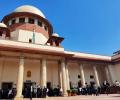
The National Judicial Commission Bill, 2022, was introduced after the majority of voice votes were in its favour.

The government on Tuesday asserted that a bill to set up a commission on appointment of judges is aimed at having a "fair procedure" for appointing judges to higher courts and it has no intention to have any confrontation with the judiciary on the issue.

The government and opposition were on Thursday united in criticising the functioning of the judiciary while seeking to scrap the collegium system of appointing judges to higher courts, saying it is essential to restore the delicate balance of power which has been disturbed.

Noted jurist Fali S Nariman on Thursday slammed the two legislations that seek to overturn the present collegium system of appointment of judges, saying they hit at the root of judicial independence and may be struck down by the Supreme Court.
The NJAC Act, which sought to overturn the collegium system of appointing Supreme Court and high court judges, was struck down by the top court in 2015.

Former Union Law Minister Ashwani Kumar has argued for replacing the existing collegium system for judicial appointments, asserting that public sentiment leans toward an alternative mechanism, potentially resembling the National Judicial Appointments Commission (NJAC). He believes that the government has the authority to propose a revised constitutional amendment for judicial appointments that would withstand judicial scrutiny. Kumar also urged the Supreme Court to establish a robust internal process to address concerns within the judiciary, including allegations against judges.

Patel emphasised that one of the most important features of the bill is the establishment of a dedicated tribunal for resolving disputes, reducing the burden on the judiciary and ensuring quicker justice.
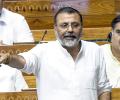
Fourth-term Bharatiya Janata Party MP Nishikant Dubey, one of the more vocal party members in the Lok Sabha, launched a broadside against the Supreme Court on Saturday, saying Parliament and state assemblies should be closed down if the apex court has to make the laws.

He will hold the office till February 9, 2027.

The collegium system of appointment of judges is likely to stay for the time being as Parliament could not pass a constitutional amendment bill in the last session of the Lok Sabha to put in place a new mechanism giving the Executive a say in the matter.

Notwithstanding reservations of judiciary, Parliament on Thursday took cleared two bills providing for a new mechanism for appointment of judges to higher judiciary by scrapping the collegium system that had come under attack from political parties and others.

Law Minister Ravi Shankar Prasad on Saturday hinted that the Narendra Modi government will rework on a constitutional amendment bill introduced by the previous dispensation which seeks to give the executive a say in appointment of judges.

A Constitutional Amendment Bill paving way for the creation of a Judicial Appointments Commission to replace the present collegium system to appoint judges to higher courts was passed in the Rajya Sabha on Thursday amid high drama with the Bharatiya Janata Party walking out.

Justice Surya Kant is set to become the 53rd Chief Justice of India, bringing extensive experience and a record of significant verdicts on key issues.

The collegium system has shut the doors of judgeship in the higher judiciary on Dalits, OBCs and even the poor among the upper castes

In a recent report, the Department-related Standing Committee on Law and Justice and Personnel said it expects the government and the judiciary to finalise the revised MoP, 'which is more efficient and transparent', in terms of a Supreme Court observation.

Keen to scrap the collegium system, government on Monday introduced a Constitution Amendment Bill in Lok Sabha to establish a six-member body for appointment of judges to the Supreme Court and the high courts.

The current session of Parliament may be extended to enable the passage of bills, Parliamentary Affairs Minister Venkaiah Naidu told Bharatiya Janata Party MPs in New Delhi on Tuesday.

While naming him as the NDA candidate for the Vice President's post, the BJP had described him as 'Kisan putra', a move seen in the political circles aimed at reaching out to the politically significant Jat community which had participated in huge numbers in the year-long farmers' protests against agriculture reform measures unveiled in June 2020.

'The (Collegium system of appointing judges) is absolutely whimsical.'

Rajya Sabha chairperson Jagdeep Dhankhar in his maiden speech in the House on Wednesday criticised the judiciary for scrapping the NJAC bill, terming it as an instance of "severe compromise of parliamentary sovereignty", and said the government's three organs should respect the "Lakshman Rekha".
The establishment of a National Judicial Commission to give the Executive a say in appointment of judges and setting up a special investigation team on blackmoney stashed abroad are the priority areas for the Modi government, newly-appointed Law Minister Ravi Shankar Prasad said.

'Is the idea of a committed judiciary once again being floated, though surreptitiously, unlike in the past when it was direct?'

Senior judges have developed a cushy arrangement among themselves: you back the appointment of so-and-so advocate's junior, and I will back so-and-so judge's nephew, says Subir Roy
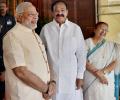
The Budget session of Parliament, the first of the Narendra Modi government, ended on Thursday reflecting the changed political reality with fewer disruptions and adjournments, and more debates and discussions unlike in the recent past.

Expressing "surprise" over the Supreme Court verdict striking down the National Judicial Appointments Commission Act, Union Law Minister D V Sadananda Gowda said.

Law Minister Arjun Ram Meghwal will attend the meetings of the committee as a special invitee, while legal affairs secretary Niten Chandra will be secretary to the panel.

The Supreme Court will hear on Monday a batch of petitions challenging the 121st constitutional amendment by which collegium system for appointment of judges in higher judiciary was scrapped and a new mechanism under National Judicial Appointment Commission was proposed to be put in place.
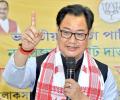
If it is opaque, then who else will speak up against it if not the concerned minister, Rijiju said.

'My question is not why he has accepted the governorship, my question is why did the government offer it to him? By his accepting it, an impression is sought to be created that judges are no better than anyone else and will accept anything.' Fali Nariman, the legendary lawyer, speaks on the controversy over the National Judicial Appointments Bill and former Chief Jusice P Sathasivam's appointment as Kerala governor in an exclusive interview.

Now, every state election -- first up, Maharashtra, Haryana and Jharkhand later this year, then Delhi in January and Bihar in September next year -- will be seen by his followers for evidence of his recovery, and by rivals of sharpening decline, points out Shekhar Gupta.

Attorney General K K Venugopal told a bench headed by Justice Bobde that the Constitution (103 amendment) Act, 2019 granting 10 per cent reservation to EWS is intended to uplift around 200 million people who are still below the poverty line.

'The BJP lacks a credible mass leader who matches Mamata Banerjee's popularity.' 'Given the division of votes among Opposition parties, the West Bengal government's dole-giving strategy, and the consolidation of the poor, significant sections of scheduled caste groups and Muslim minorities behind the ruling party, it will be difficult to dislodge the Trinamool from power.'

Former AAP leaders Yogendra Yadav and Prashant Bhushan said the Bill was completely different from the one envisaged originally.

There is an acute imbalance of power between the various organs of the State, including the executive, the legislature, the judiciary, and the ultimate sovereign -- the people, argues R Jagannathan.
The SC on Wednesday restrained all high courts from entertaining any petition challenging validity of NJAC act meant to replace the two-decade-old collegium system.
 © 2026 Rediff.com - Advertise with us - Disclaimer - Privacy Policy - Sitemap - Feedback - About us - Terms of use - Grievances